.png)


English Intercede
1998 - 2026
Sign up to receive the new editions by email when they are released
Masters of Memory: The Boys of the Madrassahs
2008 Vol. 5: Sept/Oct
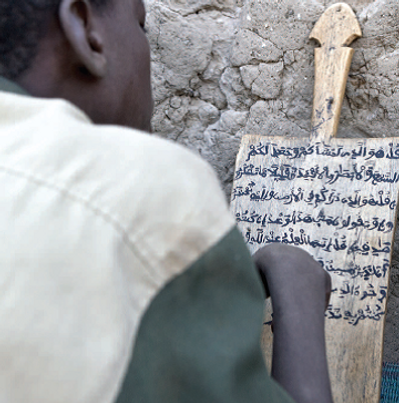
The sound begins to filter out just past dawn. At first an indistinct murmuring, the din grows as the morning lengthens and the grounds of a sun-baked school are revealed. As noon approaches, a skin of dust hangs in the air, and the jumble of sound has taken on a pace to match its volume, flowing from surrounding classrooms.
Sharing Christ with Shia Muslims
2008 Vol. 4: July/Aug
A beautiful March snow covered Dearborn as I was cross-country skiing in Hemlock Park — three blocks from my apartment. I am the chaplain for the X-C Ski Headquarters Team, and on this day I was training for the Michigan Cup relays. The X-C Team has had the good fortune to win the relays and the Michigan Cup for two years consecutively.
The Deafening Silence
2008 Vol. 3: May/June
Damascus, Syria, 2007 — As 16-year old Zahra Ezzo lay sleeping on a cold January morning, her brother Fayyez was making his way toward her apartment, driven by the most heinous intent. Using a stolen key, he slipped through her doorway around dawn, a knife at his side. Fayyez then either crouched or knelt beside his sister, drew the blade, and stabbed her — five vicious thrusts to her head and back. Immediately exiting the house, he walked directly to the nearest police station, turned himself in, and brazenly announced his actions with a full confession.

Standing at the Brink: A Time of Prayer for Somalis
2008 Vol. 2: Mar/Apr
After I taught the group English class, Asha and I walked to the small room in the back. In that back room, Asha came alive. We spent an hour practicing her English by telling each other stories from our lives. This time I asked her to walk me through the market in Mogadishu, the capital of Somalia. She began to tell me of the sounds and sights she remembered from her happy days in Somalia, and of the people she would have run into at the market. I looked her in the eyes and said, “Asha, I’d love to visit your homeland with you someday.”

Jesus in Islamic Tradition and Scripture
2008 Vol. 1: Jan/Feb
During the Crimean War in 1854, three doctors were summoned to treat a wounded military officer. His condition was utterly hopeless, but all three doctors knew that if this man died, their lives would not be spared. The setting was an Islamic country and all three doctors were Muslims. As the officer’s life was quickly fading, the doctors could only hope for a miracle. In their desperation, they did something unusual. They earnestly prayed to Prophet Jesus vowing to become his followers if he answered their prayers. Miraculously, the officer survived, and all three doctors became followers of Jesus.

A Shia Muslim Finds True Baraka
2007 Vol. 6: Nov/Dec
I was about twelve years old when I first saw the saint whom the Murids of Senegal call master, savior, and even god. I was just a city block away from our house, on my way to school, when out of nowhere, a crowd of Muslims rushed toward the Murid mosque nearby. I learned later that word had gotten out that the spiritual leader of the Murid Muslims had unexpectedly come there for prayer.
Saints and Shrines
2007 Vol. 5: Sept/Oct
Popular or folk religion always claims a connection, or even loyalty to the orthodox position — the practitioners sensing no disparity in their deviance. Thus is the paradox of our Muslim friends who petition a “saint” to intercede with Allah on their behalf or on behalf of a deceased family member. Orthodox Islam teaches there is one God, and no mediator between God and man — no one can take another’s place. Yet, when we observe the behavior of ordinary Muslims around the world, we see that the actual practices are quite different than the advertised rituals.
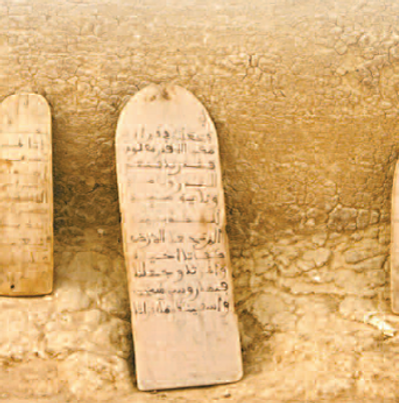
Bones, Stones, and the Hearts of Men: Compiling the Quran
2007 Vol. 4: July/Aug
His fame as a novelist came attached with a hefty price tag. More accurately, his fame came manacled to virulent strains of fundamental Islam. Until 1988 Salman Rushdie, with his heavy-lidded, pedestrian features, was an unlikely candidate for fame outside of literary circles. However, with the 1988 U.K. publication of The Satanic Verses, containing two controversial chapters relating to the Qur’an and Muhammad, Rushdie’s name became a conduit of Islamic rage.

The Forlorn: Apostates in Islam
2007 Vol. 3: May/June
Behind the veil, beneath the constricting cloak covering Islam, exists a muted minority that dares not show itself or allow its utterances to be heard. Declared members face death, ostracism and wrenching loss. Exposure costs all, bringing with it the burden of isolation; anguished individuals carom from shame to death’s edge to clandestine flight, grateful to find solace in a world of pseudonyms and assumed identity. In Islam, this is a world of incalculable risk, with exposure tapping the vein of Islamic sharia law. In Islam, this is the domain of the muted minority, the forlorn and abandoned. This is the domain of apostasy.

Lebanon: A House Divided
2007 Vol. 1: Jan/Feb
The modern nation of Lebanon has a heritage that goes back to the very dawn of human history. Its geographical position at the eastern end of the Mediterranean Sea has guaranteed its status as a cosmopolitan and multicultural center. In the Bible, Lebanon is mentioned as the source of cedar for the building of Solomon’s Temple, and as a land of abundance and beauty. To understand Lebanon’s current turmoil, we need to look at the history of the land; its people, religions and politics.

Islamic Eschatology
2007 Vol 2: Mar/Apr
One of the basic tenets of the Islamic religion is the belief in the Last Day. Like Christians, Muslim people also believe in a Day of Judgment that leads to an eternal heaven or an eternal hell. They believe the Day of
Judgment will be foreshadowed by a variety of signs to warn the world of impending judgment. Some of the signs are general. They include moral decay, religious sectarian violence, religious apathy, hypocrisy, world fires
and smoke, and major landslides. The major signs include the rise of the sun from the west, as well as the rise of three major Islamic figures: Ad-Dajjal, Isa Al- Masih and Al-Mahdi.

From All Nations--To All Nations
2006 Vol. 6: Nov/Dec
“With the almost universal hatred of Americans throughout the Muslim world because of American support for Israel, the sense of shame that ‘infidel Western Christians’ are occupying an Arab country, the prisoner abuse photos from Iraq, etc., I wonder if God has raised up these brothers and sisters [non-Americans] to fill the ranks of American missionaries who are finding it harder and harder to stay and work in Muslim lands. Yes, I th