.png)


A Clear Picture of Christ’s Crucifixion, Part 2

Updated: Apr 2
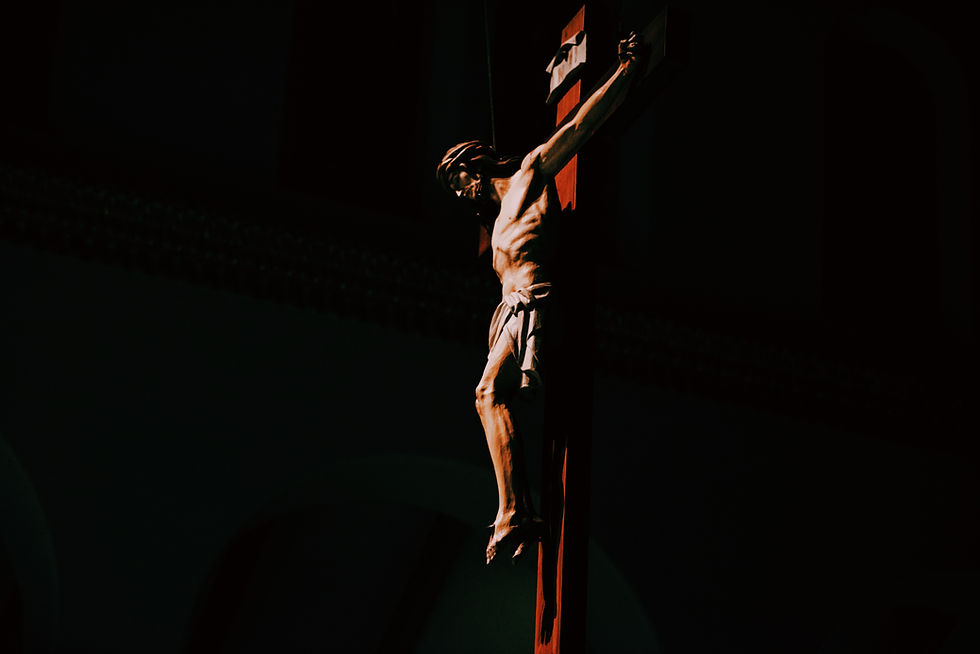
The Biblical Basis for the Crucifixion and Resurrection
The life of Jesus emerges as the center of the biblical faith. For 2,000 years, Christians have revered the Lord Jesus as the Divine Savior and Eternal Son of God. In fact, the death and resurrection of Jesus provide the historical events upon which the hinge of history swings. This is not merely the question of the sudden disappearance of a prophet, as in the case of Enoch.
The Bible contains four detailed biographies of Jesus’ life. When I was a young man, I picked up a Holy Bible and started reading it. When I got to the four Gospels, I was surprised that the story seemed to keep repeating itself! However, later I understood that God wanted to give a very detailed picture of the life of Christ.
Two of these Gospel accounts were written by John and Matthew. They were two of the twelve original disciples chosen by Jesus. They walked and talked with him daily for over three years.

John was so beloved to Jesus that He entrusted the care of His mother, Mary, to John while He was dying on the Cross.
When Jesus then saw His mother, and the disciple whom He loved standing nearby, He said to His mother, ‘Woman, behold, your son!’ Then He said to the disciple, ‘Behold, your mother!’” (John 19:26-27).
It seems unthinkable for a mother not to recognize her own son.
Mark wrote one of the four Gospel accounts of Jesus’ life. His longer name was John Mark. He was from a leading family in the Early Church. Peter was quite close to this family. Subsequent Early Church leaders note that Mark received much of the data for his Gospel from Peter.
Luke was a historical researcher who interviewed eyewitnesses of the life of Jesus. He wrote a two-part compilation known as “The Gospel of Luke” and “Acts of the Apostles.” The latter provides a historical narrative of the Early Church from the time of Jesus’ ascension until the imprisonment of Paul in Rome in the AD 60s. He provides a lot of historical anchoring for the period commencing with the birth of John the Baptist and Jesus. Notice the type of detailed, historical writing provided by Luke:
Now in the fifteenth year of the reign of Tiberius Caesar, when Pontius Pilate was governor of Judea, and Herod was tetrarch of Galilee, and his brother Philip was tetrarch of the region of Ituraea and Trachonitis, and Lysanias was tetrarch of Abilene, in the high priesthood of Annas and Caiaphas, the word of God came to John, the son of Zacharias, in the wilderness. (Luke 3:1-2)
Such data can be rigorously cross-checked, as it often has been. Such historical anchoring statements are lacking in the Qur’an. These four Gospels, ordered in Bibles as Matthew, Mark, Luke, and John, provide a solid basis from which readers can draw an informed picture of the life of Christ.
What Do the Gospels Report about the Crucifixion and Resurrection of Christ?
Readers may compare the Bible’s two verses about the ascension of Enoch, and the Qur’an’s two verses about the crucifixion of Jesus, with the biblical account of Jesus’ Crucifixion. The contrast is staggering. The four Gospels provide the following coverage of the event, from the moment Pilate delivers Jesus over for crucifixion until His burial:
Matthew 27:27-56 30 verses
Mark 15:16-41 26 verses
Luke 23:26-49 24 verses
John 19:17-37 21 verses

Therefore, the Gospels provide 101 verses on the Crucifixion of Jesus. This does not even count material on the surrounding events: Jesus’ arrest; His various trials before Pilate, Herod, and the Sanhedrin; the release of Barabbas; or the eventual burial of Christ. By providing over 100 verses of content on Christ’s Crucifixion alone, God makes a statement of emphasis about the importance of this death.
All four Gospel writers recount that Roman soldiers mocked Jesus, beat him, and took His own clothes off Him and placed a robe on Him. Matthew writes:
Then the soldiers of the governor took Jesus into the Praetorium and gathered the whole Roman cohort around Him. They stripped Him and put a scarlet robe on Him. And after twisting together a crown of thorns, they put it on His head, and a reed in His right hand; and they knelt down before Him and mocked Him, saying, “Hail, King of the Jews!” They spat on Him, and took the reed and began to beat Him on the head. After they had mocked Him, they took the scarlet robe off Him and put His own garments back on Him, and led Him away to crucify Him. (Matt. 27:27-31)
The details provided by Matthew enable the reader to picture precisely what was occurring. It is not a vague picture but a clear one.
Moving onto the actual Crucifixion, the Gospel accounts are quite similar. All four Gospels specifically stated that Jesus was crucified. They all mention the sign above His head and what was written on that sign. Mark narrates:

Then they brought Him to the place Golgotha, which is translated, Place of a Skull. They tried to give Him wine mixed with myrrh; but He did not take it. And they crucified Him, and divided up His garments among themselves, casting lots for them to decide what each man should take. It was the third hour when they crucified Him. The inscription of the charge against Him read, “THE KING OF THE JEWS.” They crucified two robbers with Him, one on His right and one on His left. (Mark 15:22-27)
Each of the four Gospel accounts states that Jesus specifically died on the cross (Matt. 27:50; Mark 15:37; Luke 23:46; and John 19:30). He did not simply swoon on the Cross due to injuries and revive later. He actually suffered physical death.
Furthermore, each of the four Gospel accounts gives an accounting of those who witnessed the Crucifixion. Mark notes these bystanders:
When the centurion, who was standing right in front of Him, saw the way He breathed His last, he said, “Truly this man was the Son of God!”
There were also some women looking on from a distance, among whom were Mary Magdalene, and Mary the mother of James the Less and Joses, and Salome. (Mark 15:39-40)
As noted above, John states that he was at the foot of the Cross next to Jesus’ mother, Mary.
Until this point, we have only considered material in the four Gospels related to the Crucifixion. A similar amount of content, if not more, is available to corroborate the resurrection of Christ from the dead. Since we have been focusing on the accounts of Jesus’ death in Christianity and Islam, we will not consider the resurrection in detail now. Suffice to say that Matthew, Mark, Luke, and John all chronicle the resurrection of Christ. Interested readers can simply read the following chapters of the Bible for these detailed accounts: Matthew 28; Mark 16; Luke 24; and John 20.

Matthew states:
Now after the Sabbath, as it began to dawn toward the first day of the week, Mary Magdalene and the other Mary came to look at the grave. And behold, a severe earthquake had occurred, for an angel of the Lord descended from heaven and came and rolled away the stone and sat upon it. And his appearance was like lightning, and his clothing as white as snow. The guards shook for fear of him and became like dead men. The angel said to the women, “Do not be afraid; for I know that you are looking for Jesus who has been crucified. He is not here, for He has risen, just as He said. Come, see the place where He was lying. Go quickly and tell His disciples that He has risen from the dead; and behold, He is going ahead of you into Galilee, there you will see Him; behold, I have told you.”
And they left the tomb quickly with fear and great joy and ran to report it to His disciples. And behold, Jesus met them and greeted them. And they came up and took hold of His feet and worshiped Him. Then Jesus said to them, “Do not be afraid; go and take word to My brethren to leave for Galilee, and there they will see Me.”
Matthew became an eyewitness of his resurrected Lord. No one prayed for Jesus to resuscitate. He rose again because He was the Son of God.
The Eternal Significance of the Gospel Accounts of Christ’s Crucifixion and Resurrection
The second question posed above probes the significance of Christ’s death and Resurrection. Was it like that of Enoch, for whom few deals are given, and which appears to be of somewhat limited eternal significance for believers? Or is Jesus’ Crucifixion and Resurrection of greater significance?
Jesus described the importance of His Crucifixion while eating the Last Supper with His disciples. Matthew describes the event at which he was present:
While they were eating, Jesus took some bread, and after a blessing, He broke it and gave it to the disciples, and said, “Take, eat; this is My body.” And when He had taken a cup and given thanks, He gave it to them, saying, “Drink from it, all of you; for this is My blood of the covenant, which is poured out for many for forgiveness of sins. (Matt. 26:26-28, emphasis added)

Now the picture has come into clear focus. Jesus died for the forgiveness of sins! The wonderful, awesome significance of Christ’s death on the Cross explains why the Easter holiday is so important for Christians. In many ways, Easter is more significant than Christmas, though both are holy and important. The death and resurrection of Christ open a door to God’s presence, which was previously unattainable.
This is why Christians celebrate Easter with such joy. After marking the sorrows of Good Friday, the jubilation of the empty tomb can hardly be contained.
The Final Picture
Since Jesus’ blood holds the key to the forgiveness of sins, godly people must have a clear picture of what happened at the Cross. A vague picture is unsatisfactory for us to assess such a crucial event in human history. The Bible provides a very clear, detailed, credible account of Jesus’ Crucifixion, as well as His Resurrection.
Everyone is encouraged to take spiritual inventory, based on the evidence at hand. Without the shedding of Christ’s blood, there is no hope for forgiveness of sins. Without His Resurrection, humans are hopeless regarding the day of resurrection, which we will all face. Yet we are not left without hope. Christ Jesus purchased the gift of salvation at Easter, not at Christmas. Will you receive that gift today?

Access the FREE downloadable booklet that includes Parts 1 & 2 of the blogs entitled, A Clear Picture of Christ's Crucifixion.
This is a great resource to use with you Muslim friend, neighbor, or co-worker. Remember, Muslims do not believe Jesus was the Son of God nor that he died on the Cross or rose from the dead. These three doctrines encompass the core of the Christian faith. Through faith in Jesus' shed blood on the cross, we have forgiveness of sins. Through the resurrection we have the hope of eternal life with Jesus!
Be bold and share the Good News of salvation with your Muslim friend! They deserve to know the TRUTH about Jesus!


